While water usage across different business sectors varies wildly, one of the biggest consumers is golf clubs.
Hot weather and a lack of rain mean more maintenance is needed to keep the greens, fairways and rough in good order. That means a great deal more water is needed.
How much water do golf clubs use?
England alone has approximately 2,200 golf courses, while Scotland has an estimated 550. From tiny 9-hole courses to internationally renowned 18-hole facilities, all need water to survive as a business.
About 820 golf clubs pull water directly from the main water network supply in England. Their estimated water use for these businesses in the summer months can be up to 24 million litres every day.
The rest of the year this drops to ten million litres with the help of rain. Other clubs without a business water licence may use local sources for irrigation, such as on-site boreholes and rainwater harvests.
How do golf clubs use water to maintain facilities?
Without water the courses become unplayable, the frustration of trying to score on dusty, uneven greens and abnormal course conditions can ruin a round. Creating a great golfing experience starts with good grass and groundskeeping.
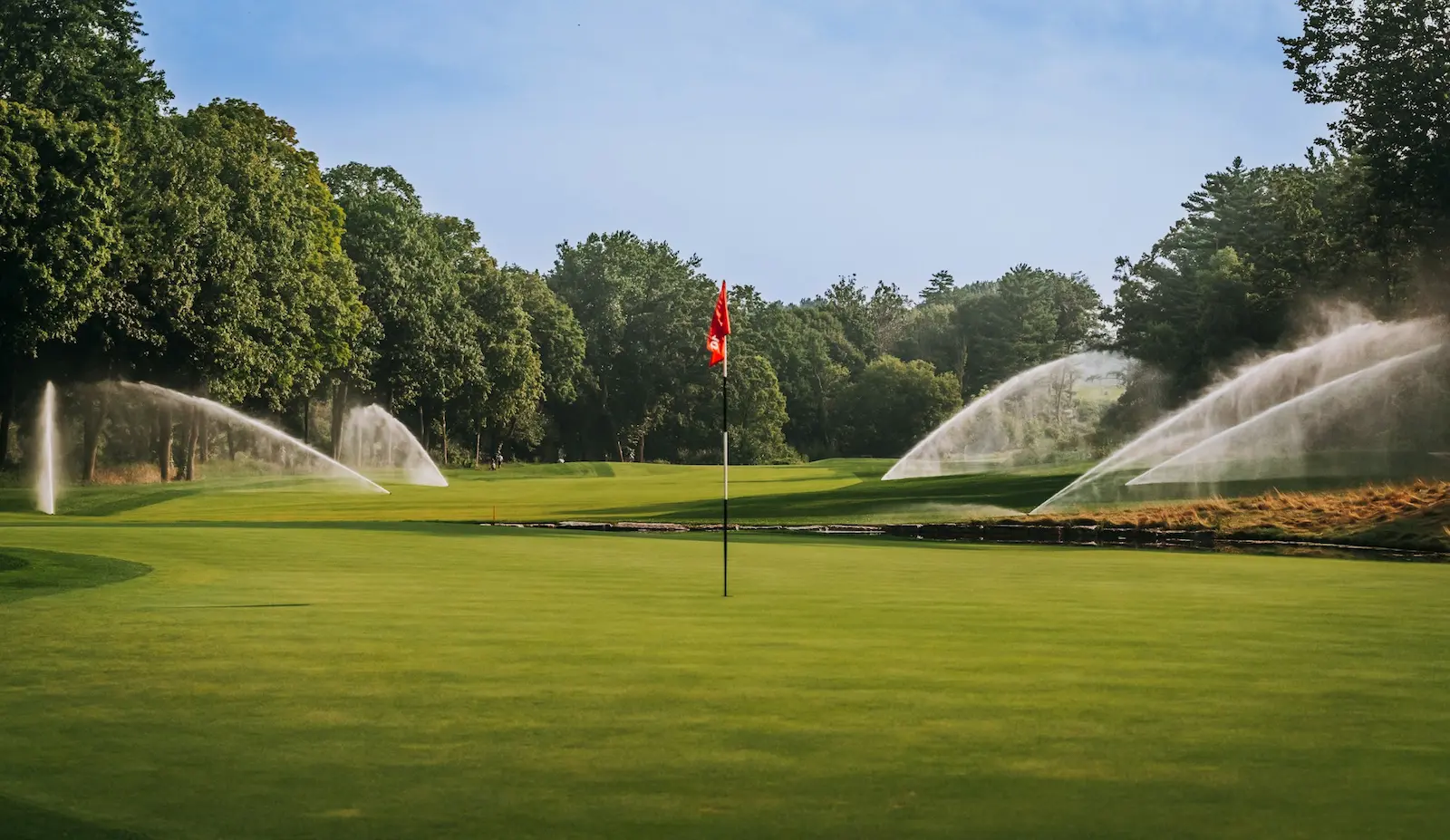
Artificially irrigating turf is the main way water is consumed by golfing facilities. Sprinklers and below-ground pipe networks supply water to thirsty soil throughout the year. In the high-end clubs it is computer-controlled to balance the moisture levels precisely.
Much of the demand is centred around key areas, such as the putting greens and fairways, the volume needed is still very high.
What is the future of water usage for golf clubs?
According to the Golf Course 2030 Water report there has been a huge increase in mains water use to maintain the grounds over the past 50 years.
The heavy reliance on mains potable water puts many golf businesses at risk, particularly with future water shortages expected. Summer droughts, rising temperatures, lower precipitation throughout the year, and ironically, floods, will likely impact business.
What is the solution to water scarcity for golf clubs?
The 2030 report, produced by R&A, calls for more sustainable practices to combat climate change and future water scarcity issues.
The three main strands of the suggested solutions are:
- Reducing water consumption through more efficient use and monitoring
- Finding more sustainable water sources, for example, on-site harvesting or grey water use
- Educating club members, managers and grounds staff in water supply awareness
Measures include water management planning to identify areas where water use can be more efficient and to reduce vulnerabilities and risks.
Promoting long-term water security across the sector would mean implementing monitoring and auditing. The data can then be used to find alternative ways to irrigate turf with water harvesting and storage.
It suggests viewing the golfing facilities in terms of a wider water landscape of the catchment area rather than as an isolated consumer. For example, local farming and industry that use adjacent land.
Short and long-term planning can provide a way to reduce environmental impact while maintaining the quality of the facilities for members.
How can switching water suppliers help golf clubs be more sustainable?
Switching water suppliers cannot only help golf clubs get cheaper business water rates, but it also has other benefits.
Water management
Some business water suppliers provide expert knowledge and have long-term strategies for improving water supply reliability and sustainability across their networks. For a golf course, this would mean more resilience in the face of summer droughts.
They can also provide ways to monitor site-wide water consumption through metering, allowing easier ways to identify leaks and inefficiencies. The data analysis can be used to locate and repair problems, or to prevent over- and under-irrigation.
Education and advice
Suppliers have expertise in water efficiency, which they can pass on to the club’s senior leadership team and grounds staff. Educating all staff in water sustainability can help save even more water and money.
Water suppliers may also have an option for bespoke services, tailored to the specific needs of the business as a major water consumer.
Alternative water sources
Water companies can sometimes assist businesses with alternative, sustainable solutions that can be implemented across the site. For example, boreholes for local water extraction.
Since the turf does not require potable water, rainwater and untreated groundwater can be used in irrigation systems.
Indirect benefits
Reducing expenditure on water bills can mean more money available for capital investment in irrigation systems and monitoring equipment.
Installing a system that responds directly to the needs of the soil and turf can make for more efficient water use and healthier, firmer, more playable grounds.
Reducing environmental impact
By switching to a water supplier that puts the environment and network reliability at the forefront of their approach, a club can contribute to improving the health of waterways and reducing pollution.